Last updated: May 2026
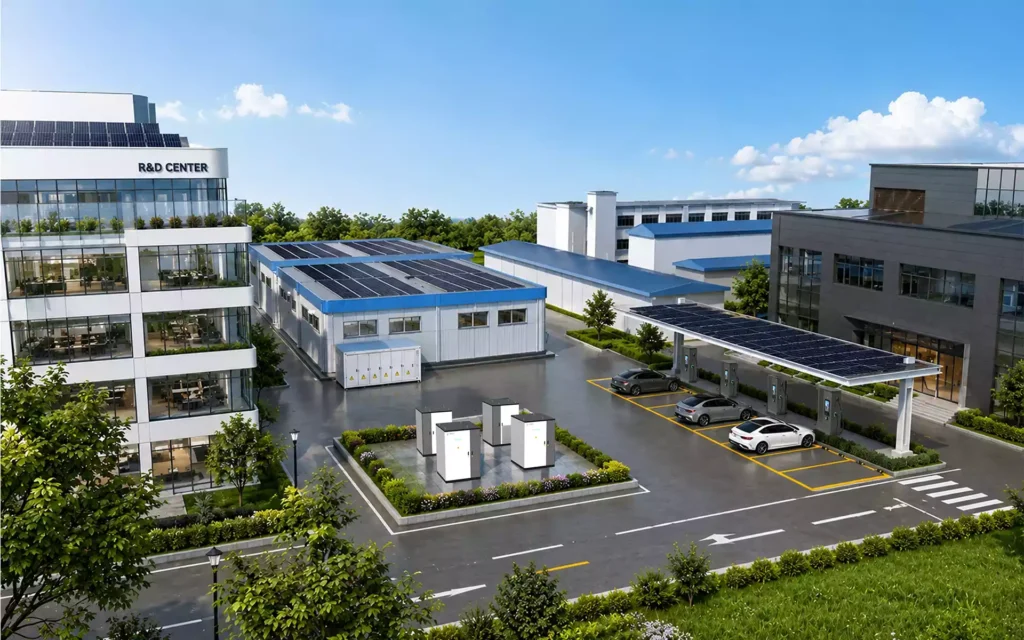
Solar battery storage is a system that stores excess electricity generated by solar panels so it can be used later, instead of only when the sun is shining. The U.S. Department of Energy describes solar-plus-storage as a battery system charged by a connected solar energy system, typically solar PV.
For buyers, the key point is simple: solar battery storage is not just “solar panels plus a battery.” Real performance depends on how the battery, inverter, controls, metering, and site load profile work together. A system that looks good on paper can still disappoint if it is not matched to the site’s actual operating pattern.
1) What is solar battery storage?
Solar battery storage refers to a system that captures excess electricity generated by solar panels and stores it for later use. Instead of exporting all surplus power immediately, the battery can hold that energy and discharge it when solar output drops, when electricity is more expensive, or when the site needs backup support.
In practical terms, solar battery storage helps a site use more of its own solar generation rather than depending entirely on real-time solar production.
2) How does solar battery storage work?
At a high level, the process is simple:
- Solar panels generate electricity during the day.
- The site uses that solar power first.
- Excess solar energy charges the battery.
- The battery discharges later when solar production is lower or when stored energy is more valuable.
That “later” may mean evening demand, a high-price period, a peak interval, or a short backup event. DOE materials emphasize that pairing solar with storage allows solar energy to be used beyond the hours when the sun is actively generating.
3) Why buyers use solar battery storage
3.1 Use more self-generated solar power
Many sites install batteries because they want to consume more of their own solar energy on-site instead of exporting it immediately.
3.2 Shift solar energy into later hours
Solar generation is often strongest when site demand is moderate. A battery helps move that energy into afternoon, evening, or shift-change periods.
3.3 Reduce peak imports
For some sites, the battery can reduce import spikes by discharging when the site is approaching a target cap.
3.4 Improve resilience
In some designs, solar battery storage can support critical loads during outages or unstable grid conditions, depending on system architecture and site requirements. DOE notes that solar-plus-storage can improve resilience and reliability under the right configuration.
4) Solar battery storage vs. solar-only
| Solar-only | Solar + battery storage |
|---|---|
| Solar power is used only when it is being generated | Solar energy can be used later as well |
| More dependence on real-time solar production | More flexibility across time windows |
| Limited value after sunset | Better ability to cover evening demand |
| Surplus generation is often exported immediately | Surplus can be stored and discharged later |
| No battery-based backup capability | Can support resilience, depending on design |
This is why solar-only and solar-plus-storage should not be treated as interchangeable systems. They solve different operational problems.
5) What affects solar battery storage performance most
5.1 Usable capacity
Installed battery capacity is not the same as usable energy. Reserve buffers, thermal conditions, system losses, and ageing all affect how much energy is actually available.
5.2 Power capability
The battery also needs enough power delivery to support the intended use case. A system designed for shifting energy is not automatically optimized for peak control.
5.3 Control logic
The value of the battery depends on dispatch. When the system charges and discharges matters as much as the battery hardware itself.
5.4 Site load profile
A site with strong midday surplus and meaningful evening load is very different from a site with a flat profile or minimal solar excess.
5.5 Data visibility
Without interval data, event logs, and clear control logic, it becomes much harder to verify whether the battery is performing as intended.
6) Common buyer mistakes
6.1 Assuming all excess solar can be captured
Not every site produces enough usable surplus to justify storage. The real question is how much exportable solar is available after on-site consumption.
6.2 Ignoring usable vs. installed capacity
A battery may have an attractive nameplate number but less usable energy than expected under real conditions.
6.3 Forgetting the evening demand profile
The battery is valuable only if there is a meaningful load or tariff window to shift into.
6.4 Treating the battery as backup only
Backup is only one possible use case. Many projects create more value through self-consumption, shifting, or peak support.
6.5 Not checking data export and control visibility
If the buyer cannot access interval data, dispatch logs, and alarm history, performance becomes much harder to validate later.
7) Is solar battery storage worth it?
That depends on the site.
Solar battery storage is usually more attractive when a site has:
- strong daytime solar surplus
- a meaningful evening or late-day load
- high-value import periods
- peak charges or strong operational reasons to reduce grid dependence
- enough interval data to model performance properly
It is usually less attractive when:
- solar surplus is small
- the load profile is already flat
- tariff signals are weak
- the battery would spend most of its time underused
The answer is not “yes” or “no” in general. It depends on how the solar profile, site load, and battery control logic fit together.
8) Can solar energy be stored for night use?
Yes. That is one of the main reasons solar battery storage exists. Energy generated during the day can be stored and later discharged when solar output is low or unavailable. DOE’s solar-plus-storage resources explicitly frame storage as a way to use solar electricity beyond daylight production hours.
FAQ
Solar battery storage is a system that stores electricity generated by solar panels so it can be used later instead of only during solar production hours.
It charges from excess solar generation, stores that energy, and discharges later when the site needs it or when solar production is lower.
Yes. Solar energy can be stored in batteries for later use, which is one of the main functions of solar-plus-storage systems.
At night, the battery can discharge stored solar energy if it still has usable charge available.
At night, the battery can discharge stored solar energy if it still has usable charge available.
It can be, especially when a site has meaningful solar surplus, valuable later-hour demand, or a need to improve resilience.
Often yes, but results depend on the site load profile, tariff structure, battery controls, and how much usable solar surplus is available.
Sometimes, but only if the system is designed for backup operation and the site architecture supports it.
Project lifetimes often extend over many years, but actual battery life depends on cycling, temperature, operating strategy, and system design.
Next step
If you want to evaluate whether solar battery storage makes sense for your site, start with:
- 12 months of interval load data, if available
- your solar production profile
- tariff rules or peak-charge structure
- site constraints such as transformer headroom and available footprint
Those four inputs usually reveal whether the opportunity is real — and what kind of system architecture makes sense.
References
- U.S. Department of Energy, Solar Energy and Storage Basics. Accessed: May 2026.
- U.S. Department of Energy, Solar-Plus-Storage 101. Accessed: May 2026.
- American Clean Power, Energy Storage Facts and Information. Accessed: May 2026.