European electricity prices are no longer just high — they are increasingly unpredictable. One January morning in 2025, high renewable output combined with low demand pushed wholesale prices below zero for four consecutive hours in Germany. Businesses without storage paid normal rates anyway. Businesses with storage charged their batteries for free — and in some cases received a payment to do so.
Only weeks earlier, the same market had seen some of its highest wholesale price levels of the year.
This is the new reality of European commercial energy: extreme swings between cheap and expensive power, often within the same day. For industrial and commercial businesses, this volatility is either a serious cost risk or a significant profit opportunity — depending entirely on whether you have a battery energy storage system (BESS) intelligent enough to act on it.
This guide explains how peak-valley arbitrage works, where the biggest opportunities exist in Germany and the UK, and what a realistic return on investment looks like for a mid-sized European business deploying a C&I storage system today.
What Is Peak-Valley Arbitrage — and How Does It Work?
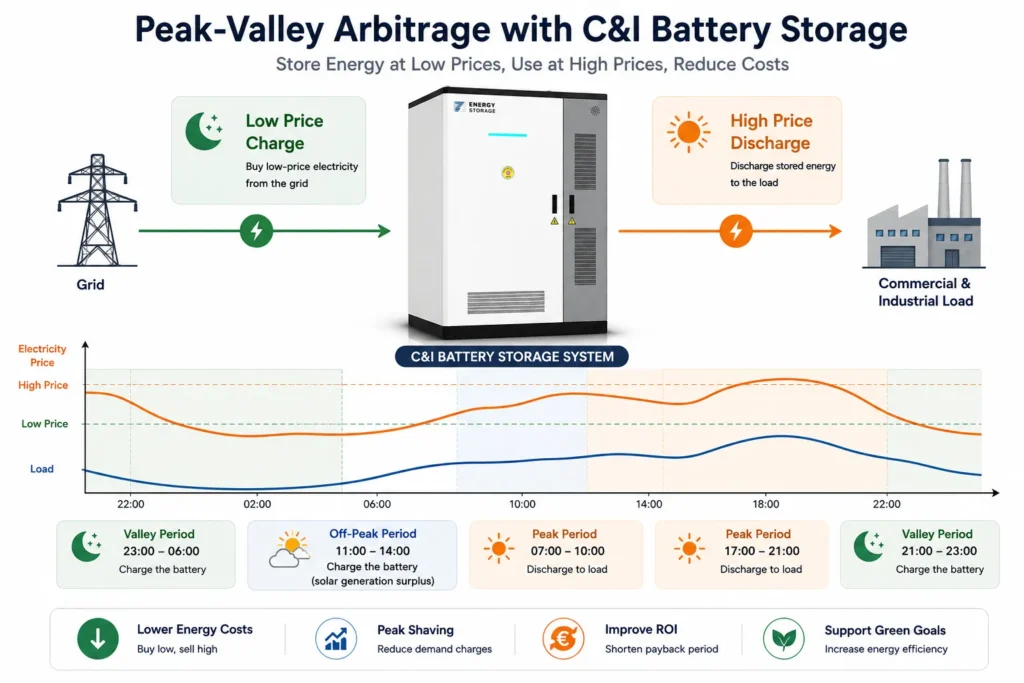
Peak-valley arbitrage is straightforward in principle: charge your batteries when electricity is cheap, discharge them when electricity is expensive. The difference in price, multiplied across hundreds of charge-discharge cycles per year, generates measurable savings on your energy bill.
Modern electricity markets in Europe operate on dynamic pricing structures known as Time-of-Use (TOU) tariffs. Under these tariffs, the price of electricity varies by hour — sometimes dramatically. Overnight and midday (when solar generation peaks), prices tend to fall. On weekday evenings, when industrial demand converges with household consumption, prices spike.
A well-configured BESS monitors these price signals in real time and executes a simple strategy:
- Charge during low-price windows (typically 23:00–06:00 and 11:00–14:00 on sunny days)
- Discharge during high-price windows (typically 07:00–10:00 and 17:00–21:00)
- Hold reserve capacity for unplanned demand spikes or grid outage backup
This is distinct from — but often combined with — peak shaving, which focuses specifically on reducing the highest demand moments in a billing period to lower capacity charges. The two strategies complement each other naturally: a battery that arbitrages price differences also smooths demand peaks as a byproduct.
The European Opportunity: Germany and the UK
Germany: Dynamic Tariffs, Negative Prices, and a Policy Tailwind
Germany is Europe’s largest electricity market, and it is undergoing a structural transformation that makes arbitrage both more valuable and more accessible.
The price volatility story is stark. According to Epex Spot data, Germany recorded around 457 hours of negative wholesale electricity prices in 2024, highlighting how renewable output can push wholesale power prices below zero — a 60% increase from the year before. France logged 356 hours; Spain experienced negative prices for the first time ever. This is a direct consequence of the renewable energy boom: in 2024, 62.7% of Germany’s electricity came from renewables (Fraunhofer Institute), and the EU as a whole set a record with renewables covering 48% of total generation. When wind, solar, and other renewables flood the grid simultaneously against low demand and constrained system flexibility, prices collapse. When they don’t, prices spike.
The policy landscape provides an equally compelling tailwind. From 2025, dynamic tariffs are becoming more widely available in Germany, supported by regulatory change and the ongoing Smart Meter Gateway rollout. Businesses now have increasing access to more dynamic price signals, especially as dynamic tariffs and smart meter rollout expand. The Federal Network Agency (Bundesnetzagentur) reported an average industrial electricity price of approximately €10.04 cents/kWh in September 2025, but forward contracts for 2026 were already trading at around €90/MWh on the exchange. The spread between off-peak spot prices (sometimes negative) and peak contract rates creates genuine arbitrage margin.
For businesses with energy-intensive operations — manufacturing, cold storage, data processing, logistics — the financial case for storage has never been clearer.
United Kingdom: Flexible Tariffs and Grid Services Revenue
In the UK, dynamic and half-hourly tariff models have expanded arbitrage opportunities for commercial users. Retail providers such as Octopus Energy have helped popularise this model, with prices varying from near-zero during overnight wind surges to over 50p/kWh during winter evening peaks.
Beyond simple arbitrage, storage in the UK may also access additional value streams through flexibility and balancing markets, depending on aggregation arrangements, metering readiness, and market eligibility. For qualifying C&I systems, these stacked revenue streams can materially shorten payback periods.
What Can a C&I Storage System Actually Save? A Real-World ROI Calculation
The following is an illustrative example based on a simplified site profile and should not be treated as a universal project outcome. Consider a mid-sized German manufacturing facility with the following profile:
- Annual electricity consumption: 800,000 kWh
- Average blended tariff: €0.22/kWh (including taxes, grid fees, and procurement)
- Peak demand charge: €12/kW/month for the top monthly demand reading
- Typical daily peak demand: 250 kW
- Installed BESS: 200 kWh / 100 kW (liquid-cooled C&I system)
Arbitrage savings calculation:
Assuming an average peak-to-off-peak spread of €0.12/kWh and the battery completing 1.8 cycles per day on average across the year:
Daily arbitrage revenue: 200 kWh × €0.12 × 1.8 cycles × 90% efficiency = €38.88/day
Annual arbitrage savings: ~€14,190/year
Peak shaving savings calculation:
By discharging during the two highest-demand hours each day, the facility reduces its peak demand reading by approximately 80 kW:
- Monthly peak charge reduction: 80 kW × €12 = €960/month
- Annual peak shaving savings: ~€11,520/year
Total annual savings: approximately €25,710
At a fully installed system cost of €110,000–€130,000 for a 200 kWh liquid-cooled C&I BESS (including installation, BMS, and grid connection), the simple payback period falls between 4.2 and 5.0 years — well within the 10–15 year operating life of a quality LFP battery system.
Factor in Germany’s negative-price events (where the battery can charge at zero or negative cost), rising electricity prices, and potential grid services revenue, and the economic case strengthens further. In stronger tariff environments or with stacked value streams, some projects may achieve payback periods below five years. Actual project economics depend on tariff design, battery utilisation, connection constraints, and site-specific operating conditions.
How Does the System Know When to Charge and Discharge?
Manual scheduling based on a fixed timetable is how first-generation storage systems worked. Modern C&I BESS solutions do something far more sophisticated.
PVB’s Energy Management Unit (EMU) continuously ingests real-time electricity price signals, weather forecasts, and the facility’s historical consumption patterns. It runs an optimisation algorithm that determines the ideal charge and discharge schedule for each upcoming 24-hour window — automatically, without operator intervention.
The integrated Battery Management System (BMS) monitors cell-level voltage, temperature, and state of charge in real time, ensuring the battery always operates within safe parameters while maximising useful capacity. If grid prices shift unexpectedly mid-day (as they frequently do in volatile spot markets), the EMU recalculates and adjusts the schedule accordingly.
The result is a system that captures a significantly higher proportion of available arbitrage value than a fixed schedule would — while eliminating the operational burden on facility energy managers.
For businesses operating across multiple sites, PVB’s cloud monitoring platform provides a unified dashboard with real-time performance data, historical generation and savings reports, and remote configuration — accessible from any device.
What to Look for When Choosing a C&I Storage System for Europe
Not all battery storage systems are equal, and the European market has specific requirements that buyers should evaluate carefully.
Chemistry: LFP vs. NMC. Lithium iron phosphate (LFP) chemistry is the standard choice for C&I applications. It offers a longer cycle life (typically 4,000–6,000 full cycles), better thermal stability, and no cobalt supply chain exposure. Nickel manganese cobalt (NMC) chemistry offers higher energy density but shorter cycle life and higher thermal management costs — making it better suited to applications where space is severely constrained.
Cooling architecture: air-cooled vs. liquid-cooled. For systems above 100 kWh operating in European climates, liquid cooling offers significant advantages: tighter cell temperature uniformity extends cycle life, and the system can operate comfortably through both cold Northern European winters and warm Southern European summers. PVB’s C&I range offers both air-cooled and liquid-cooled configurations from 100 kWh to 5 MWh, allowing the right choice for each project’s environment and budget.
Certifications for European markets. Ensure any system carries IEC 62619 (safety for stationary lithium batteries), CE marking, and UN 38.3 (transport safety). For UK projects, UKCA marking is required post-Brexit. German projects must comply with VDE-AR-N 4105 (low-voltage grid connection) or VDE-AR-N 4110 (medium-voltage), depending on connection point — non-compliant systems cannot legally connect to the grid. Always verify certifications before procurement.
Cycle life and warranty. A 10-year warranty covering capacity retention above 80% is the industry baseline. Better manufacturers provide 15-year warranties with clearly defined degradation curves. Ask specifically about warranted cycles, not just calendar years — a system used intensively for arbitrage will accumulate cycles faster than a backup-only installation.
Local service and support. In the European market, after-sales response time matters. Grid connection issues, BMS firmware updates, and occasional cell replacements require technically qualified local support. Evaluate the manufacturer’s European service network before committing to a system.
The Window Is Open — But Not Forever
European energy markets are in the middle of a structural shift that won’t repeat itself. The combination of aggressive renewable build-out, mandatory dynamic tariffs, and still-elevated baseline electricity prices has created an arbitrage window that is wide, well-documented, and commercially accessible.
The businesses installing C&I storage systems today are locking in payback periods well within the operating life of the assets they deploy. The businesses waiting for “more certainty” will face a narrowing spread as the market matures, higher installation costs as demand for skilled installers rises, and competitors who have already turned their energy bills into a structural cost advantage.
The figures above are indicative only. Actual performance depends on tariff structure, load profile, battery utilisation, and control strategy.
Ready to Calculate Your Savings?
Every facility has a different consumption profile, tariff structure, and peak demand pattern. The numbers above are indicative — your actual savings will depend on your specific situation.
For businesses and energy managers: Contact PVB for a free site assessment. Our engineering team will analyse your consumption data and provide a project-specific ROI model, system sizing recommendation, and payback projection.
For distributors and EPC contractors: PVB’s C&I storage range covers 100 kWh to 5 MWh in both air-cooled and liquid-cooled configurations, with full BMS, PCS, EMU, and fire protection integration. We support European project development from technical design through commissioning and after-sales service.
References
- EPEX SPOT, “Basics of the Power Market — Negative Prices,” epexspot.com. Accessed: May 2026. https://www.epexspot.com/en/basicspowermarket
- Fraunhofer Institute for Solar Energy Systems ISE, “Public Electricity Generation 2024: Renewable Energies cover more than 60 Percent of German Electricity Consumption for the First Time,” January 2025. Accessed: May 2026. https://www.ise.fraunhofer.de/en/press-media/press-releases/2025/…
- Bundesnetzagentur, industrial electricity price data, September 2025. Via Gleiss Lutz, “Germany cuts costs for electricity-intensive companies from 1 January 2026,” December 2025. Accessed: May 2026. https://www.gleisslutz.com/en/know-how/…
- European Commission / ACER, EU renewable electricity share data, 2024. Accessed: May 2026.