
Commercial and industrial (C&I) energy storage systems have become core infrastructure in 2026 — enabling cost optimization, resilience, and renewable integration for factories, logistics parks, EV charging stations, data centers, and large commercial buildings.
With electricity price volatility, demand charges, grid congestion, and tighter compliance requirements, many businesses now evaluate battery energy storage systems (BESS) as a system-level investment rather than a hardware purchase. Choosing the wrong system architecture, thermal design, safety compliance path, cybersecurity posture, data governance model, or control strategy can weaken ROI and create long-term operational risk.
Table of Contents
- What Is C&I Energy Storage?
- Why Businesses Invest in 2026
- Typical Applications (2026 Update)
- Key Components (What to Check)
- Thermal Management: Liquid Cooling vs Air Cooling
- Battery Chemistry: Mainstream vs Emerging
- Cost Breakdown + Battery Passport
- ROI Logic + Pro Tip
- Digital Twin + SoH visibility + Predictive O&M
- Safety, Compliance, and Insurability
- Cybersecurity + Data Ownership
- How to Choose (2026 Checklist)
- Financing Options + Contract Risk
- Common Mistakes
- FAQ
- Glossary
What Is Commercial & Industrial Energy Storage?
A commercial and industrial energy storage system is a behind-the-meter (BTM) battery solution that stores electricity and dispatches it strategically based on load demand, electricity pricing, and operational priorities.
- High and fluctuating power demand
- Frequent charge/discharge cycles
- Peak shaving and demand charge reduction
- Backup power and operational continuity
- Integration with solar PV and EV charging infrastructure
- Increasingly, grid-support capabilities under high renewable penetration
Why Businesses Invest in C&I Energy Storage in 2026
- Electricity price volatility and TOU tariffs
- Demand charges and peak penalties
- Grid reliability and power quality risks
- Solar self-consumption optimization
- ESG and decarbonization reporting readiness
- Compliance requirements expanding into lifecycle traceability and cybersecurity
- Bankability and insurance approval as a go/no-go gate in many projects
Typical C&I Energy Storage Applications (2026 Update)
| Application | What it delivers | Buyer notes |
|---|---|---|
| Peak shaving | Lower demand charges | Most ROI-sensitive to data granularity |
| TOU arbitrage | Charge off-peak, discharge on-peak | Depends on tariff spread and operating constraints |
| Solar + storage | Higher self-consumption | Works best with curtailment/export limits |
| EV charging support | Smoother charging peaks | Reduces grid upgrade pressure |
| Power quality | Voltage/frequency stability | Critical for precision loads |
| STS / Island Mode | Continuity during grid events | Often discussed around 10–20 ms (architecture-dependent) |
| Grid-Forming (selective) | Stability in weak-grid / renewable-heavy sites | Often higher CAPEX than grid-following |
Key Components of a C&I Energy Storage System
- Battery system (typically LFP)
- BMS: cell-level monitoring, protections, SoH (State of Health) tracking
- PCS: DC/AC conversion, protection coordination, grid interaction
- EMS: dispatch logic and revenue optimization
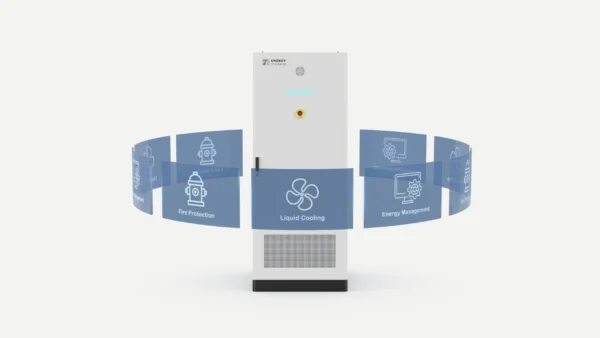
- Thermal management: air or liquid cooling
- Fire safety and protection (2026 buyer expectation): detection, isolation, and suppression should be evaluated for both life safety and asset protection.
- Module-level suppression: early-stage mitigation closer to the source (often reduces propagation and limits asset loss).
- Container/cabinet-level suppression: typically later-stage response; if triggered, the system may face extended downtime and potential asset write-off.
Procurement tip: request suppression triggers, sensor logic, and post-event recovery procedures — not just “we have suppression.”
- Cybersecurity layer (2026 critical requirement)
- Digital O&M stack: monitoring, diagnostics, and lifecycle performance tracking
Thermal Management in 2026: Liquid Cooling vs Air Cooling
Liquid cooling is the default choice for most mid-to-high-end C&I projects in 2026. Air cooling remains relevant mainly for smaller, low-cycling, or highly cost-sensitive deployments.
- Tighter temperature uniformity under high cycling
- Reduced degradation and longer usable life
- Higher energy density and smaller footprint
- Improved stability in hot climates and reduced derating risk
Procurement tip (O&M risk check): confirm the coolant replacement cycle, verify leak detection sensors, and request real maintenance procedures to minimize long-term O&M risk.
Battery Chemistry: Mainstream vs Emerging Options (2026)
LFP remains the dominant and most bankable chemistry for mainstream C&I procurement in 2026 due to its proven thermal stability, long cycle life, and mature supply chain.
Sodium-ion and other emerging chemistries are gaining traction in specific niches (e.g., ultra-low-cost or high-cycling applications), but buyers should conduct thorough due diligence on bankability, warranty/guarantee terms, and lifecycle validation before adopting them at scale.
Commercial Energy Storage Cost Breakdown (2026 Buyer View)
- Battery system, PCS, EMS
- Installation and commissioning
- Grid connection and protection equipment
- O&M and monitoring services
- Permitting and insurance requirements
- End-of-life (EoL) costs and recovery value
2026 Procurement Insight: Battery Passport and Traceability
As regulations tighten, leading systems increasingly feature Battery Passports and traceability mechanisms to support carbon footprint tracking, supply chain transparency, and simplified recycling at end-of-life.
- Confirm whether Battery Passport / traceability is supported where applicable.
- Confirm a recycling agreement or take-back pathway.
- Define EoL cost boundaries (or residual value) to avoid future compliance debt.
How ROI Is Generated in C&I Energy Storage (2026 Logic)
Common value streams include demand charge reduction, TOU arbitrage, solar self-consumption, avoided downtime, and — in eligible markets — VPP participation or ancillary services.
Pro Tip (ROI Reality Check): Reminder: The best ROI is often found in sites with a high peak-to-average load ratio and significant TOU price spreads. If your load is flat or your tariff spread is small, oversizing storage can quickly destroy payback assumptions.
ESG and Carbon Value (2026 Update)
Storage can support REC/green claims (subject to local rules), structured carbon accounting outputs, and sustainability-linked financing where measurable KPIs are required. For export-oriented manufacturers, stronger carbon data readiness may improve compliance posture in EU supply chains under the broader CBAM context.
Digital Twin + Digital O&M (2026 Upgrade)
Leading suppliers increasingly offer digital twin simulation and digital O&M that go beyond basic dashboards. A 1:1 digital twin — built from load profiles, tariff rules, PV production, and constraints — can predict revenue more accurately, reduce commissioning and tuning time, and lower early-operation performance risk.
Digital O&M procurement expectations
- Require online access to not only SoC (State of Charge), but also SoH visibility and degradation trends.
- Define annual capacity fade limits (or equivalent performance guarantees) in the contract.
- Confirm whether analytics support proactive maintenance rather than reactive fault handling.
Contract tip: Ensure the SoH measurement methodology (calculation logic, test conditions, baseline definition, and audit procedure) is clearly defined to avoid disputes during performance audits. Without a shared methodology — lab-based vs field-based testing, temperature normalization, and usable capacity definition — SoH guarantees can become difficult to enforce.
Asset-grade Digital O&M (2026 expectation): Advanced platforms should integrate AI-enabled predictive maintenance that detects early degradation and operational anomalies — for example, string/cluster imbalance, rising internal resistance, or cooling efficiency decline — and triggers proactive workflows. The goal is to shift O&M from “fault response” to health assurance, maximizing asset availability, extending useful life, and protecting bankability.
Warranty vs Performance Guarantee (common contract trap)
- Warranty (device warranty): If something breaks, it will be repaired or replaced.
- Performance guarantee: Even if nothing is broken, if usable capacity, efficiency, or availability falls below agreed thresholds, compensation applies.
Many disputes happen because suppliers provide only device warranty, while the buyer’s ROI depends on performance guarantees tied to capacity fade, round-trip efficiency, and availability. Ensure performance metrics, test methods, audit cadence, and remedies are explicitly stated.
Safety, Compliance, and Bankability (2026 Reality)
For behind-the-meter storage, safety compliance determines whether the project can be permitted, insured, and financed.
Insurability is the ultimate test of safety. In many 2026 projects, the system’s ability to obtain insurance coverage — and the resulting premium level — directly determines whether the ROI model is viable.
Insurance-first procurement step: before signing contracts, submit relevant safety documentation — especially UL 9540A thermal runaway evaluation reports — to your insurance broker or insurer for review.
- UL 9540: system-level safety (U.S. context)
- UL 9540A: thermal runaway evaluation often referenced by AHJs/insurers
- NFPA 855: installation and siting requirements that impact permitting and insurance
Siting strategy directly impacts cost. If spacing or siting does not meet fire-code requirements, the project may require added mitigation such as firewalls, enhanced ventilation, or sprinkler systems — costs that can directly reduce ROI.
Cybersecurity in 2026: EMS as a Critical Infrastructure Target
Because EMS is often cloud-connected and remotely accessible, cybersecurity is increasingly treated as an audit-level requirement — especially for data centers and government-related projects.
- Alignment with industrial cybersecurity frameworks such as IEC 62443 (where applicable)
- Encryption, authentication, role-based access control
- Logging, patch management, and remote access governance
- Clear cybersecurity responsibilities in service scope and contracts
- Clarify data ownership and residency (where the energy data is stored and who owns it). Define acceptable storage region(s), access rights, retention period, and offboarding process contractually.
How to Choose the Right Commercial Energy Storage System (2026 Checklist)
- Start with your load profile (ideally at 15-minute intervals for at least 12 months). Peak demand charges and arbitrage value are highly sensitive to data granularity. A 15-minute interval is commonly aligned with utility billing and provides a practical baseline for ROI simulation. If your site has high load volatility (e.g., EV charging hubs), consider even finer intervals where available.
- Match architecture to scenario (cabinet-based vs containerized).
- Validate EMS capability and reporting outputs.
- Define resilience requirements early (STS/island mode; grid-forming only if needed).
- Confirm safety compliance, permitting readiness, and the insurance path.
- Confirm lifecycle transparency and end-of-life handling.
- Evaluate service readiness, cybersecurity posture, and data governance model.
- Require digital O&M visibility (SoH visibility, degradation trend, capacity fade limits) and ensure contract enforceability.
Financing Options: CAPEX Is Not the Only Path (2026 Tip)
- Leasing / financing lease: spreads cost over time and preserves cash flow.
- EMC / ESCO: “zero upfront cost” models where the provider invests and shares savings or revenue.
- Shared savings / revenue-sharing: economics aligned with measured performance.
Contract note (critical for EMC/ESCO / revenue-sharing): define the baseline methodology, performance guarantee responsibilities, and how revenue volatility caused by tariff changes or grid rule updates is allocated between parties.
Common Mistakes Buyers Should Avoid (2026)
- Choosing based on battery price only
- Underestimating permitting, insurance, and siting/fire-code constraints
- Oversizing without a clear ROI model
- Ignoring cybersecurity readiness and data residency risks
- Not defining service response and warranty vs performance guarantee boundaries in contracts
- Ignoring end-of-life handling (recycling agreements, residual value, compliance requirements)
- Over-specifying advanced capabilities without need (driving CAPEX up)
FAQ
Is commercial energy storage safe?
Yes. When designed with LFP chemistry, robust thermal management, and documented compliance, C&I storage is generally considered safe. Safety is ultimately validated through permitting and insurability in the target market.
When should I require grid-forming capability?
Consider it for weak-grid sites, renewable-heavy microgrids, or projects needing stability support and potential black start readiness. Note: Grid-forming inverters are typically more expensive than grid-following ones, so avoid over-specifying if the use case does not require it.
How long does a C&I energy storage system last?
Typically 10–15 years depending on cycling intensity, temperature control, and maintenance strategy.
What digital metrics should I require for O&M?
At minimum, require SoC, alarms, and event logs. For serious projects, require SoH visibility, degradation trend analytics, and contract-defined capacity fade limits — with an agreed methodology and audit procedure.
Next Step
Align your load profile, tariff structure, resilience requirements, and compliance constraints with the right architecture and EMS strategy — then evaluate suppliers not only on hardware specs, but also on bankability, insurability, cybersecurity readiness, data ownership/residency, lifecycle transparency, and long-term service capability.
Suggested next clicks: