
A commercial and industrial battery energy storage system does not become bankable the day it is delivered. It becomes bankable when it is commissioned correctly, monitored continuously, maintained predictably, and supported by clear operating records. For C&I buyers, EPCs, facility managers, and asset owners, BESS operation and maintenance is where technical design turns into long-term performance.
Many battery storage projects begin with sizing, battery chemistry, PCS capacity, cooling design, and total installed cost. Those topics are important, and PVB has covered them in guides such as How to Size a C&I Battery Storage System, BESS Components: BMS vs PCS vs EMS, and C&I BESS Cost Guide. But after installation, a different set of questions becomes more important.
Is the BESS operating within its approved temperature range? Are cell voltage deviations increasing? Are alarms being reviewed or ignored? Is the EMS following the intended charging strategy? Are availability, round-trip efficiency, state of health, and maintenance records being tracked in a way that supports warranty claims, insurance reviews, and financial reporting?
This guide explains how to build a practical BESS operation and maintenance framework, from commissioning and site acceptance testing to daily monitoring, preventive maintenance, performance KPIs, documentation, and supplier support.
Table of Contents
- What Is BESS Operation and Maintenance?
- Why BESS O&M Matters for C&I Projects
- BESS Commissioning and Site Acceptance Testing
- What to Monitor in Daily BESS Operation
- Preventive Maintenance Schedule
- Key Performance KPIs for BESS Assets
- Alarm Management and Fault Response
- Warranty, Records, and Bankability
- How to Choose a Supplier for Long-Term O&M
- FAQ
What Is BESS Operation and Maintenance?
BESS operation and maintenance, often called BESS O&M, is the set of technical, operational, and documentation activities used to keep a battery energy storage system safe, available, efficient, and compliant throughout its operating life.
Operation covers how the system is used every day. It includes charging and discharging strategy, EMS settings, BMS monitoring, PCS operation, alarm handling, data review, remote supervision, and site-level coordination with loads, solar PV, generators, grid connection limits, or electricity price signals.
Maintenance covers planned and corrective actions. It includes inspections, firmware updates, filter cleaning or replacement, cooling system checks, connection inspection, fire protection review, communication checks, alarm testing, sensor validation, and replacement of consumable or aging components when needed.
For buyers who are still evaluating system architecture, PVB’s What Is BESS? guide explains the complete system structure before the O&M phase begins.
Why BESS O&M Matters for C&I Projects
For commercial and industrial projects, BESS O&M is not only a technical service. It directly affects uptime, return on investment, warranty protection, insurance confidence, safety performance, and the owner’s ability to prove that the asset is operating as designed.
1. Availability Determines Business Value
A battery storage system only creates value when it is available during the periods when it is needed. If a system is offline during a demand peak, price spike, backup event, or scheduled dispatch window, the financial model can be affected even if the hardware itself is technically installed.
For a C&I site using BESS for peak shaving, low availability can increase demand charges. For a factory using BESS for backup support, low availability can increase downtime risk. For a site participating in energy scheduling, poor availability can reduce arbitrage or flexibility value.
2. Battery Degradation Must Be Managed
Battery degradation is normal, but uncontrolled degradation is not. Temperature, depth of discharge, C-rate, cycling frequency, high state-of-charge dwell time, and operating strategy all influence long-term battery health. O&M helps ensure the system follows operating limits that match warranty conditions and project economics.
The goal is not to avoid cycling completely. A storage asset must operate to create value. The goal is to use the battery in a controlled way that balances revenue, resilience, and long-term state of health.
3. Safety Depends on Continuous Visibility
BESS safety is designed into the system through cell selection, BMS protection, thermal management, fire detection, electrical protection, enclosure design, and installation practices. But safety also depends on ongoing operation. Alarms, abnormal temperature trends, communication failures, insulation faults, coolant issues, ventilation problems, and repeated PCS trips should not be ignored.
PVB has covered safety and insurability in BESS Insurability & Fire Safety in Europe. This O&M guide focuses on what happens after the system is commissioned and running.
4. Records Protect Warranty and Insurance Claims
When a performance question, fault event, or warranty claim occurs, the owner needs records. Useful records may include commissioning reports, alarm history, maintenance logs, firmware versions, operation curves, availability records, temperature data, SoC and SoH trends, and service reports. Without records, it becomes harder to show whether the system was operated within its approved limits.
BESS Commissioning and Site Acceptance Testing
Commissioning is the bridge between construction and operation. A BESS should not be treated as fully operational simply because equipment has arrived onsite and cables are connected. Commissioning confirms that the system has been installed, configured, tested, and documented according to the approved design.
For C&I projects, commissioning should usually include factory documentation review, visual inspection, electrical verification, communication checks, protection settings, functional tests, EMS logic review, safety system checks, and site acceptance testing.
Commissioning Checklist
- Verify system model, serial numbers, battery capacity, PCS rating, and cabinet or container layout.
- Confirm installation matches drawings, cable schedules, grounding design, and site electrical requirements.
- Inspect enclosure, HVAC or liquid cooling system, battery racks, PCS, switchgear, emergency stop, and warning labels.
- Check torque records, cable termination, insulation resistance, grounding continuity, and protection devices.
- Confirm BMS, PCS, EMS, meter, fire detection, and communication interfaces are online.
- Review firmware versions, parameter settings, charge and discharge limits, SoC limits, and temperature thresholds.
- Test alarms, emergency stop, remote shutdown, communication loss response, and protection coordination.
- Run controlled charge and discharge tests under approved conditions.
- Record baseline performance data for future comparison.
- Complete site acceptance test reports and handover documentation.
| Commissioning Area | What to Verify | Why It Matters |
|---|---|---|
| Electrical installation | Cabling, grounding, protection, metering, isolation, phase sequence | Reduces electrical fault risk and supports safe operation |
| Battery system | Module status, BMS communication, voltage consistency, SoC calibration | Establishes a safe and reliable operating baseline |
| PCS | Charge/discharge response, grid synchronization, protection settings | Ensures power conversion works as intended |
| EMS | Dispatch rules, peak shaving logic, schedule control, site power limit | Confirms the system follows the business model |
| Thermal management | Cooling startup, airflow or coolant behavior, temperature sensors | Protects battery life and safety performance |
| Safety systems | Fire detection, alarms, emergency stop, shutdown logic | Supports compliance, insurance, and emergency response |
What to Monitor in Daily BESS Operation
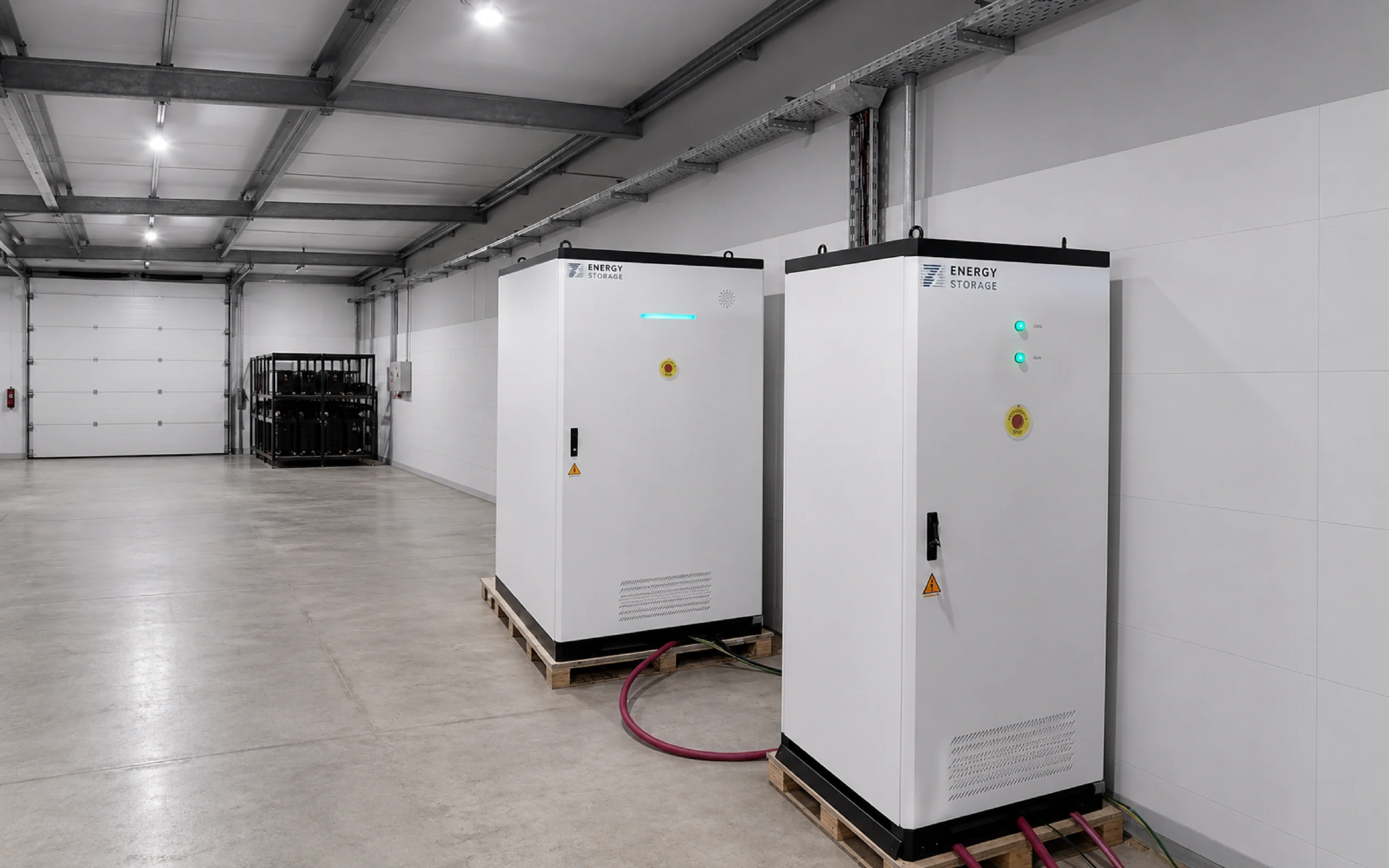
Once the system is running, daily operation should focus on visibility. The operator does not need to manually inspect every data point every hour, but the monitoring platform should make abnormal trends visible before they become failures.
Battery Monitoring
- State of charge (SoC)
- State of health (SoH)
- Cell, module, rack, and system voltage
- Cell voltage deviation
- Battery current and charge/discharge rate
- Battery temperature and temperature spread
- Cycle count and equivalent full cycles
- Alarms related to overvoltage, undervoltage, overtemperature, and communication faults
PCS and Electrical Monitoring
- AC power output and input
- Reactive power or power factor settings where applicable
- DC bus voltage
- PCS operating mode
- Conversion efficiency
- Grid voltage and frequency
- Breaker status and protection trips
- PCS temperature and fault history
EMS and Site-Level Monitoring
- Charging and discharging schedule
- Peak shaving performance
- Site load profile
- Grid import and export
- PV generation if solar is connected
- Demand charge reduction or tariff response
- Backup reserve settings
- Remote control commands and user access history
If a BESS is being used for energy cost optimization, the EMS should be reviewed regularly against the actual tariff structure. A strategy that worked under one electricity price schedule may become less effective if demand charges, time-of-use periods, or market prices change.
Preventive Maintenance Schedule
Preventive maintenance is the planned work that keeps a BESS in reliable condition. The exact schedule depends on supplier instructions, site environment, product type, duty cycle, local rules, and warranty requirements. However, most C&I projects should define daily, monthly, quarterly, annual, and event-based maintenance tasks.
| Frequency | Typical Tasks | Owner’s Goal |
|---|---|---|
| Daily or remote continuous | Review system status, alarms, SoC, power output, site load, temperature trends | Identify abnormal operation early |
| Monthly | Check alarm logs, communication status, ventilation or cooling status, EMS dispatch records | Confirm the system is following the operating plan |
| Quarterly | Inspect enclosure, filters, fans, coolant indicators, cable condition, visible corrosion, labels, access control | Prevent environmental and mechanical issues |
| Semi-annual | Review protection settings, firmware status, fire detection system, emergency stop, maintenance records | Keep controls and safety functions aligned |
| Annual | Perform detailed system inspection, thermal system service, performance review, availability report, warranty record review | Support long-term asset management and bankability |
| Event-based | Inspect after severe weather, abnormal alarms, repeated trips, impact damage, water intrusion, overheating, or grid events | Confirm safe return to service |
Key Performance KPIs for BESS Assets
Good O&M requires measurable indicators. Without KPIs, the owner may not know whether the system is performing well, drifting gradually, or failing to deliver the value promised in the business case.
| KPI | What It Measures | Why It Matters |
|---|---|---|
| Availability | Percentage of time the BESS is ready to operate | Directly affects energy savings, backup readiness, and revenue potential |
| Round-trip efficiency | Energy discharged compared with energy charged | Helps evaluate system losses and energy economics |
| State of health | Remaining battery health compared with original condition | Supports degradation tracking and warranty review |
| Equivalent full cycles | Total cycling workload normalized to full cycles | Helps compare actual use with warranty assumptions |
| Peak reduction | How much demand peak is reduced by battery dispatch | Shows whether peak shaving logic is creating value |
| Alarm frequency | Number and severity of alarms over time | Identifies recurring issues before they become failures |
| Temperature spread | Difference between battery temperature points | Can reveal cooling imbalance or abnormal module behavior |
| Response time | How quickly the system follows EMS or grid commands | Important for peak shaving, backup, and flexibility services |
These KPIs should be reviewed in context. A lower round-trip efficiency may be normal during low-power operation. A lower SoH may be acceptable if degradation matches the warranty curve. A high number of alarms may be harmless if they are informational, but serious if they include repeated protection trips or temperature warnings.
Alarm Management and Fault Response
Alarm management is one of the most important parts of BESS O&M. A system can generate many alarms, but not all alarms have the same urgency. Operators need a clear response plan that separates informational alerts, warning-level conditions, and critical faults.
Typical Alarm Categories
- Battery alarms: voltage deviation, high temperature, low temperature, overcurrent, insulation fault, SoC abnormality.
- PCS alarms: grid fault, overtemperature, DC bus abnormality, breaker trip, communication loss.
- EMS alarms: dispatch failure, meter data loss, schedule conflict, site power limit warning.
- Thermal alarms: fan fault, coolant issue, HVAC failure, high cabinet temperature.
- Safety alarms: smoke detection, fire system warning, emergency stop, door access, water intrusion.
Fault Response Workflow
- Confirm the alarm source and determine whether the system has already entered a protective state.
- Check real-time data such as temperature, voltage, current, SoC, PCS status, and communication status.
- Follow the supplier’s emergency or service procedure for critical alarms.
- Do not repeatedly restart the system without understanding the root cause of serious protection trips.
- Document the event with timestamp, alarm code, operating condition, action taken, and final status.
- Escalate to qualified service personnel when the issue involves safety, electrical protection, battery abnormality, fire detection, or repeated faults.
Warranty, Records, and Bankability
Warranty protection depends on more than the warranty document. It also depends on operating conditions and records. Many BESS warranties include conditions related to temperature range, cycling, depth of discharge, SoC limits, maintenance requirements, firmware, and allowed operating modes.
For C&I owners, strong documentation helps answer three important questions:
- Was the BESS operated within approved limits?
- Was maintenance performed according to supplier requirements?
- Is the current performance consistent with the warranty and financial model?
Records Owners Should Keep
- Commissioning and site acceptance test reports
- As-built drawings and electrical diagrams
- Equipment serial numbers and firmware versions
- Operating limits and EMS dispatch strategy
- Alarm logs and fault reports
- Maintenance checklists and service records
- SoH, SoC, temperature, cycle count, and availability reports
- Warranty documents and supplier correspondence
- Fire safety inspection and emergency response documentation where applicable
For projects involving external financing, insurance review, or performance guarantees, these records can become part of the bankability package. They help demonstrate that the system is being managed professionally rather than passively.
How to Choose a Supplier for Long-Term O&M
Supplier selection should include more than battery price and nameplate capacity. Long-term O&M support can decide whether the project remains reliable after commissioning. Buyers should evaluate whether the supplier can support both the hardware and the operational data needed for long-term asset management.
Questions to Ask Before Procurement
- Does the supplier provide commissioning support and site acceptance test documentation?
- Can the BMS, PCS, and EMS provide the data needed for O&M reporting?
- Are remote monitoring and alarm notification supported?
- What preventive maintenance tasks are required, and how often?
- What are the warranty limits for temperature, cycling, SoC, and depth of discharge?
- How are firmware updates handled?
- What spare parts or consumables may be needed over the system life?
- How quickly can the supplier respond to critical faults?
- Can the system support future expansion or EMS strategy changes?
PVB provides commercial and industrial energy storage solutions designed around system-level integration, including battery modules, PCS coordination, BMS protection, EMS logic, thermal management, and monitoring support. For C&I applications, see PVB’s Commercial and Industrial Energy Storage Solution and product pages such as the 125kW/261kWh Liquid Cooling Energy Storage System.
Practical BESS O&M Checklist for C&I Owners
| Stage | Owner Action | Expected Output |
|---|---|---|
| Before commissioning | Review drawings, operating limits, warranty terms, maintenance requirements | Clear handover expectations |
| Commissioning | Complete inspection, functional testing, protection checks, EMS logic validation | Signed site acceptance report |
| First month | Review alarms, dispatch performance, temperature trends, SoC behavior | Early operation baseline |
| Routine operation | Track availability, efficiency, SoH, cycles, alarms, and savings | Monthly asset report |
| Preventive maintenance | Inspect enclosure, cooling, communications, safety systems, and records | Maintenance log and corrective actions |
| Annual review | Compare actual operation with warranty, ROI model, and site energy strategy | Performance and bankability review |
Final Thoughts
BESS operation and maintenance is where a battery storage project proves its real value. A well-designed system can still underperform if commissioning is weak, alarms are ignored, EMS settings are not reviewed, or maintenance records are incomplete. A moderately sized system, managed properly, can often deliver stronger long-term value than a larger system operated blindly.
For C&I buyers, the best approach is to treat O&M as part of procurement from the beginning. Ask how the system will be commissioned. Ask what data will be available. Ask how alarms will be handled. Ask how warranty conditions are documented. Ask how preventive maintenance will be performed. These questions protect safety, uptime, and ROI.
A bankable BESS is not just a battery, PCS, and EMS installed on site. It is an operating asset with a clear maintenance plan, a monitoring framework, a performance record, and a supplier capable of supporting the system after handover.
FAQ
What is BESS operation and maintenance?
BESS operation and maintenance is the set of activities used to keep a battery energy storage system safe, available, efficient, and compliant. It includes monitoring, dispatch management, preventive maintenance, alarm response, documentation, and performance review.
Why is commissioning important for a BESS?
Commissioning confirms that the BESS has been installed, configured, tested, and documented correctly before normal operation. It helps verify electrical safety, BMS and PCS communication, EMS logic, protection settings, and site acceptance requirements.
What should be monitored in a BESS?
Operators should monitor SoC, SoH, voltage, current, temperature, cell deviation, PCS status, EMS dispatch, site load, alarms, availability, efficiency, and cycle count. The exact data points depend on system design and application.
How often does a BESS need maintenance?
Maintenance frequency depends on supplier requirements, site conditions, duty cycle, and local rules. Many C&I systems use continuous remote monitoring plus monthly, quarterly, semi-annual, annual, and event-based maintenance activities.
What are the most important BESS performance KPIs?
Important KPIs include availability, round-trip efficiency, state of health, equivalent full cycles, peak reduction, alarm frequency, temperature spread, and response time. These indicators help evaluate both technical performance and business value.
Can poor O&M affect BESS warranty?
Yes. Warranty terms may include limits related to temperature, cycling, SoC, depth of discharge, maintenance, firmware, and operating conditions. Good O&M records help show that the system was operated within approved limits.
Who should perform BESS maintenance?
BESS maintenance should be performed by qualified personnel following supplier documentation, local electrical codes, and site safety procedures. Critical alarms, electrical faults, fire system issues, and battery abnormalities should be escalated to trained service teams.
Sources and Further Reading
- NFPA – NFPA 855: Standard for the Installation of Stationary Energy Storage Systems (Accessed: 10 June 2026)
- UL Solutions – UL 9540A Test Method for Battery Energy Storage Systems (Accessed: 10 June 2026)
- PVB – BESS Components Guide: BMS vs PCS vs EMS (Accessed: 10 June 2026)
- PVB – How to Size a C&I Battery Storage System (Accessed: 10 June 2026)
- PVB – BESS Insurability & Fire Safety in Europe (Accessed: 10 June 2026)