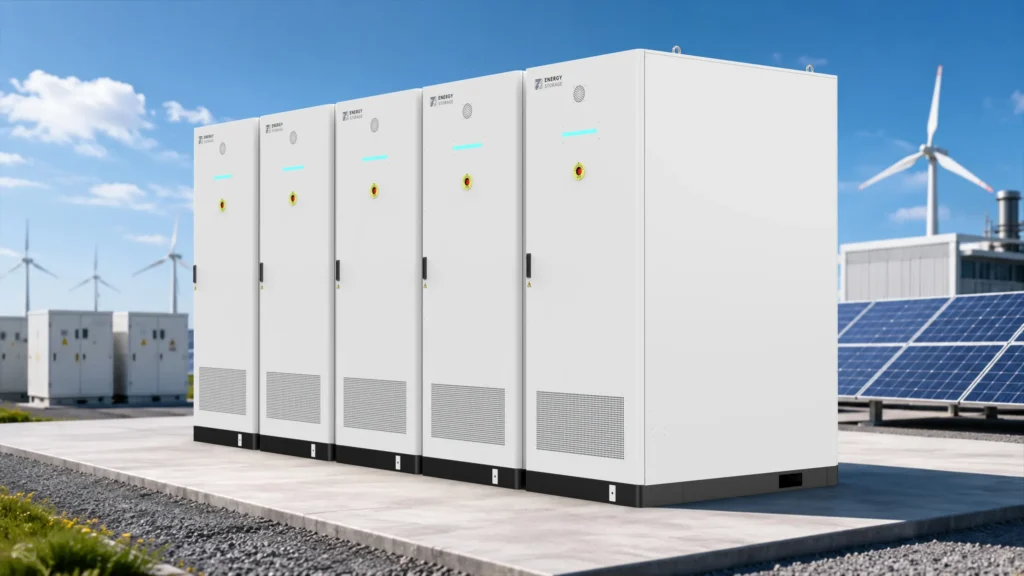
A battery energy storage system uses electricity even when it is not delivering useful power to the factory. Cooling equipment, pumps, heaters, controls, communications, fire-safety devices and other support systems all need energy. This internal demand is called auxiliary power consumption, station service or parasitic load.
The customer buys a BESS to move electricity, but part of that electricity is used to keep the BESS operating safely. If a proposal reports only battery or PCS efficiency and leaves out HVAC and other auxiliaries, the customer may overestimate net output and savings.
Ask every supplier to state the measurement boundary, operating conditions, standby load and whether guarantees are gross or net of auxiliaries.
Power at the PCS or battery terminals is not automatically the power delivered at the project meter.
Cooling or heating demand varies with temperature, humidity, loading and enclosure design.
A continuous standby load consumes a larger share of value when the system cycles infrequently.
1. What Counts as BESS Auxiliary Power?
Auxiliary power is the electricity consumed by equipment that supports the storage system rather than serving the customer’s load or the grid. The exact list depends on the product and project boundary.
| Auxiliary load | What it does | Why consumption changes |
|---|---|---|
| HVAC or liquid-cooling system | Controls battery and power-electronics temperature. | Ambient temperature, humidity, solar gain, power level and control setpoints. |
| Pumps and fans | Move coolant or air through the equipment. | Cooling architecture, operating state, filter condition and control strategy. |
| BMS, EMS and controllers | Monitor cells, calculate limits and coordinate dispatch. | Normally smaller but often continuous, including standby periods. |
| PCS support equipment | Cools and controls bidirectional power conversion. | Load, switching state, temperature and PCS design. |
| Fire and safety systems | Maintain detection, alarms, ventilation and other designed safety functions. | System architecture and operating mode; some functions must remain energized. |
| Communications, lighting and security | Support monitoring, networking, service access and site operation. | Project scope and whether loads sit inside the guaranteed boundary. |
2. Gross Power, Net Power and the Measurement Boundary
Before comparing figures, mark the measurement points on the single-line diagram. A 100 kW PCS rating describes a power-conversion capability at a defined terminal. It does not prove that 100 kW will be available to the factory after every internal load and electrical loss.
The contract should say whether rated power, usable energy and efficiency are measured at the battery DC terminals, PCS AC terminals, low-voltage bus, transformer high-voltage side or point of connection. Without that definition, two apparently similar guarantees may describe different things.
How is auxiliary power supplied?
There is no single arrangement for every BESS. Auxiliary equipment may be supplied from the site’s AC board, an auxiliary transformer, a dedicated station-service circuit or an internal connection within the packaged system. The source can also change between normal grid-connected operation and an outage.
The single-line diagram should show where the auxiliary supply starts, which meter records it and what keeps essential controls, communications, heating, cooling and safety equipment operating during backup or black-start conditions. This is an engineering and commercial question: the supply arrangement affects net output, outage duration and which electricity appears on the customer’s bill.
3. How Auxiliary Loads Change Round-Trip Efficiency
Round-trip efficiency compares energy recovered during discharge with energy used to charge the system over a defined test. The result changes with the measurement boundary, power level, state-of-charge range, temperature, rest time and treatment of auxiliary consumption.
Using the same point for charging and discharging is essential. If charging energy is measured at the site meter but discharge energy is reported at the PCS terminals, the calculation hides part of the loss.
An annual economic model also needs standby consumption. A short factory test performed near rated power may not represent a system that sits ready for long periods, operates at partial power or experiences hot and cold seasons.
4. A Simple C&I Example
Assume a factory expects the BESS to deliver 200 kW during a peak. If the support systems draw 8 kW at that moment and those loads sit inside the customer’s measured boundary, the net contribution may be approximately 192 kW before any other site losses.
If the demand-charge target requires the grid import to remain below a firm limit, that 8 kW matters. The EMS setpoint, PCS headroom or selected system power may need to account for it. This example is explanatory only; actual auxiliary demand is product- and condition-specific.
The same logic applies to energy. An always-on average auxiliary load of 2 kW uses 48 kWh in one day. Whether that is material depends on system size, use pattern, tariffs and which source supplies the auxiliary circuit.
5. Why HVAC and Cooling Usually Need the Most Attention
Battery cells and power electronics operate within defined temperature limits. The thermal-management system helps keep temperatures and temperature differences within the product’s control strategy. Its demand is not fixed.
- Higher ambient temperature can increase cooling work.
- Cold conditions can create heating demand before charging or high-power operation.
- High charge and discharge power produces more heat than standby operation.
- Blocked filters, fouled heat exchangers or low coolant can reduce effectiveness.
- Direct sun, poor airflow and tight equipment spacing can worsen site conditions.
- Control setpoints and firmware can change when pumps, fans or compressors operate.
Do not choose air cooling or liquid cooling from a slogan. Compare total system performance under the project’s temperature, dust, humidity, altitude, sound and maintenance conditions. Tighter temperature control may support battery performance, but the complete design and operating duty determine the outcome.
Cold-climate research also shows why HVAC cannot be treated as a fixed footnote. A published peak-shaving study found that including enclosure heating and cooling loads could materially change the optimized BESS power, energy and cost in extreme-cold locations. Its numerical results belong to the modeled NMC system and eight U.S. locations—not to every C&I project—but the practical lesson is broadly useful: model the local climate and thermal design instead of copying one auxiliary percentage.
6. Auxiliary Power During Standby, Charging and Discharging
| Operating state | Buyer question | Possible economic effect |
|---|---|---|
| Shutdown or storage | Which circuits remain energized, and how is the battery protected? | Long idle periods may still have energy and maintenance requirements. |
| Standby / ready | What is the steady demand at each ambient condition? | Continuous consumption can reduce annual savings for infrequently used systems. |
| Charging | Are auxiliaries supplied from the grid, PCS output or a separate circuit? | Raises the purchased energy required to store a given amount. |
| Discharging | Is guaranteed output gross or net of auxiliary demand? | Can reduce power available for peak shaving or contracted delivery. |
| Backup / islanded | Must the BESS support its own cooling and controls from stored energy? | Reduces energy available to critical facility loads. |
7. How Auxiliary Consumption Changes BESS Sizing
The simple screening formula of power multiplied by time gives the AC energy required by the site. Nameplate battery energy must then account for the usable state-of-charge window, conversion losses, auxiliary demand, required reserve and end-of-life capacity.
Use 15-minute load data for initial C&I BESS sizing, but ask whether faster data is needed for short peaks, motor events or control response. Keep every assumption visible rather than hiding auxiliaries inside an unexplained oversizing percentage.
8. What Should Appear in the Supplier Datasheet?
A single “system efficiency” line is not enough. Ask for a schedule that separates operating states and test conditions.
- standby consumption at stated ambient conditions;
- maximum and representative HVAC, pump and fan demand;
- auxiliary consumption during charge and discharge at defined power;
- heating demand and cold-start restrictions;
- measurement boundary for every efficiency and energy value;
- whether transformer, site controller, fire systems and external HVAC are included;
- derating curves for temperature and altitude;
- test method, duration, state-of-charge window and calibration requirements.
For products with integrated auxiliaries, confirm which loads are already included in the product rating. For containerized projects, also identify common plant loads outside each container.
9. Put the Same Definitions into the Contract
The commercial model, technical specification, warranty and acceptance test should use the same boundary. Otherwise the feasibility study may predict net savings while the guarantee only protects a component-level value.
| Contract item | Definition needed |
|---|---|
| Rated power | Gross or net, measurement point, duration, power factor and environmental condition. |
| Usable energy | Beginning- and end-of-life basis, SoC window, temperature and auxiliary treatment. |
| Round-trip efficiency | Test boundary, cycle, power level, rest periods and included loads. |
| Availability | What counts as unavailable and how derating, communications and planned maintenance are treated. |
| Performance test | Meters, accuracy, sampling, ambient limits, data treatment and retest process. |
| Remedy | Correction plan, repeat test and commercial consequence for a verified shortfall. |
Link these terms to the BESS warranty and performance-guarantee review. Do not assume that a battery-capacity warranty also guarantees site-level efficiency or operating cost.
10. How to Test Auxiliary Power at FAT and SAT
Factory testing can confirm product operation under controlled conditions. Site testing confirms the installed system, wiring, meters and project boundary. Neither should be replaced by a screenshot of a nominal efficiency value.
- Agree the instruments: identify revenue meter, auxiliary feeders and equipment meters.
- Record conditions: ambient temperature, battery temperature, SoC, power setpoint and operating state.
- Measure standby: allow the system to reach a defined stable condition.
- Measure charging and discharging: use agreed power levels and durations.
- Check individual feeders: separate cooling, controls and other major loads where practical.
- Reconcile meters: confirm that the energy balance closes within agreed accuracy.
- Repeat under relevant conditions: one mild-temperature test may not represent the annual site.
- Save raw data: preserve timestamps, meter files, alarm logs and configuration versions.
Use PVB’s BESS FAT and SAT checklist to place this measurement inside the wider commissioning plan.
11. Monitor It After Commercial Operation
Auxiliary demand should not disappear from view after acceptance. Trend energy by subsystem, temperature, season and operating state. A rising cooling load can indicate dirty filters, blocked airflow, degraded equipment, changed setpoints or another condition needing investigation.
- track daily and monthly auxiliary kWh;
- separate standby, charging and discharging periods;
- normalize results against ambient temperature and throughput where useful;
- set alerts for unexpected baseload or repeated cycling;
- connect work orders to alarms and performance changes;
- review whether the dispatch schedule still produces value after all internal consumption.
The BESS operation and maintenance guide explains how monitoring, preventive work, alarms and records fit into the long-term operating program.
12. What to Send PVB for a Net-Performance Review
- required net power and energy at the defined site point;
- application and expected annual operating schedule;
- interval load data and electricity tariff;
- ambient temperature, humidity, altitude, dust and installation layout;
- single-line diagram and auxiliary supply arrangement;
- backup loads and required duration, if applicable;
- measurement, efficiency, availability and warranty requirements.
PVB can use these inputs to match the battery, PCS and thermal-management configuration to the intended C&I duty. Final project results depend on the installed design, control strategy, operating conditions and agreed measurement boundary.
Explore the PVB commercial and industrial energy storage solution and compare suitable cabinet or container formats for the site.
- Auxiliary power
- Electricity used by the BESS’s supporting equipment rather than delivered as the main service.
- Gross power
- Power measured before specified internal loads or downstream losses are deducted.
- Net power
- Power available at the agreed project measurement point after included consumption and losses.
- Station service
- Another term for the electrical supply used by supporting plant equipment.
- Round-trip efficiency
- Discharged energy divided by charging energy under a defined test and boundary.
- Throughput
- Total energy charged, discharged or both, as defined by the contract.
13. FAQ: BESS Auxiliary Power Consumption
What is auxiliary load in a BESS?
It is the electricity used to operate the storage system’s supporting equipment, such as HVAC, pumps, controls, communications and safety systems. It is different from the main energy delivered to the factory or grid.
How much power does BESS HVAC consume?
There is no reliable universal figure. Demand changes with enclosure design, battery and PCS heat, ambient temperature, humidity, operating state, setpoints and equipment condition. Ask for measured standby, charging and discharging values under stated temperatures.
What is the biggest auxiliary load in a C&I BESS?
Thermal management often deserves the most attention, but the answer depends on product design, climate, operating state and project boundary. Request measured consumption by subsystem rather than assuming a universal percentage.
Is HVAC included in BESS round-trip efficiency?
Sometimes, but not automatically. The supplier must define the test boundary and included loads. A PCS or DC efficiency value can exclude HVAC, pumps, transformers and other project losses.
Does a BESS use power while idle?
Yes. Controls, communications, safety systems and temperature management may need energy in standby. Ask for steady standby consumption under stated conditions.
Should auxiliary power be added to PCS size?
It must be included in the system power balance. Whether additional PCS rating is required depends on where auxiliaries are supplied, the required net output, operating cases and equipment architecture.
How do auxiliaries affect backup duration?
When the BESS must power its own support systems during an outage, that energy reduces what remains for critical facility loads. Include both in the backup energy calculation.
Can buyers compare auxiliary consumption using one percentage?
Not reliably. Consumption varies with ambient conditions, utilization, cooling design and included equipment. Compare suppliers using the same duty cycle, conditions and measurement boundary.
14. References
The following open sources support the system-level treatment of auxiliary consumption and performance. Project requirements and adopted standards must be confirmed for the destination market.
- National Laboratory of the Rockies — Best Practices for Operation and Maintenance of Photovoltaic and Energy Storage Systems, 3rd Edition (accessed September 8, 2026).
- BC Hydro — Battery Energy Storage System Best Practices, January 2026 (accessed September 8, 2026).
- Energy Market Authority of Singapore — Handbook for Energy Storage Systems, Operation and Maintenance chapter (accessed September 8, 2026).
- Energy — Impact of Heating and Cooling Loads on Battery Energy Storage System Sizing in Extreme Cold Climates (accessed September 8, 2026).
- Politecnico di Milano — Battery Energy Storage System Performance in Providing Various Electricity Market Services (accessed September 8, 2026).